We use a build system.
Note: this section is an MVP. Tests pass, but functionality is incomplete :-) I will soon improve it.
For a single developer, a compiler is all needed. Scripts can take a team a bit further. But at scale, no script is good enough. Build systems have undergone many years of development, making them far more flexible and robust.
Bazel
is fast: do not build things twice if they have already been built somewhere else
is correct: the output faithfully reflects the state of its transitive inputs (hermetic, reproducible, deterministic build analysis and action execution)
benefits from good architecture and thus guides in that direction
is widely used by projects of the size we have
was explicitly developed for large complex codebases
has a proven track record even in the automotive environment (BMW)
has external support from consulting companies and tooling for remote execution, caching, and reporting.
We as TTTech have decided to switch to Bazel as our sole build system for our software to
enhance the developer experience
reduce feature development time
increase delivery quality
end efficient use of our resources
We limit engineers’ power and flexibility
The maybe biggest advantage of a build system is the clear API that enables us to split work:
This has 2 advantages:
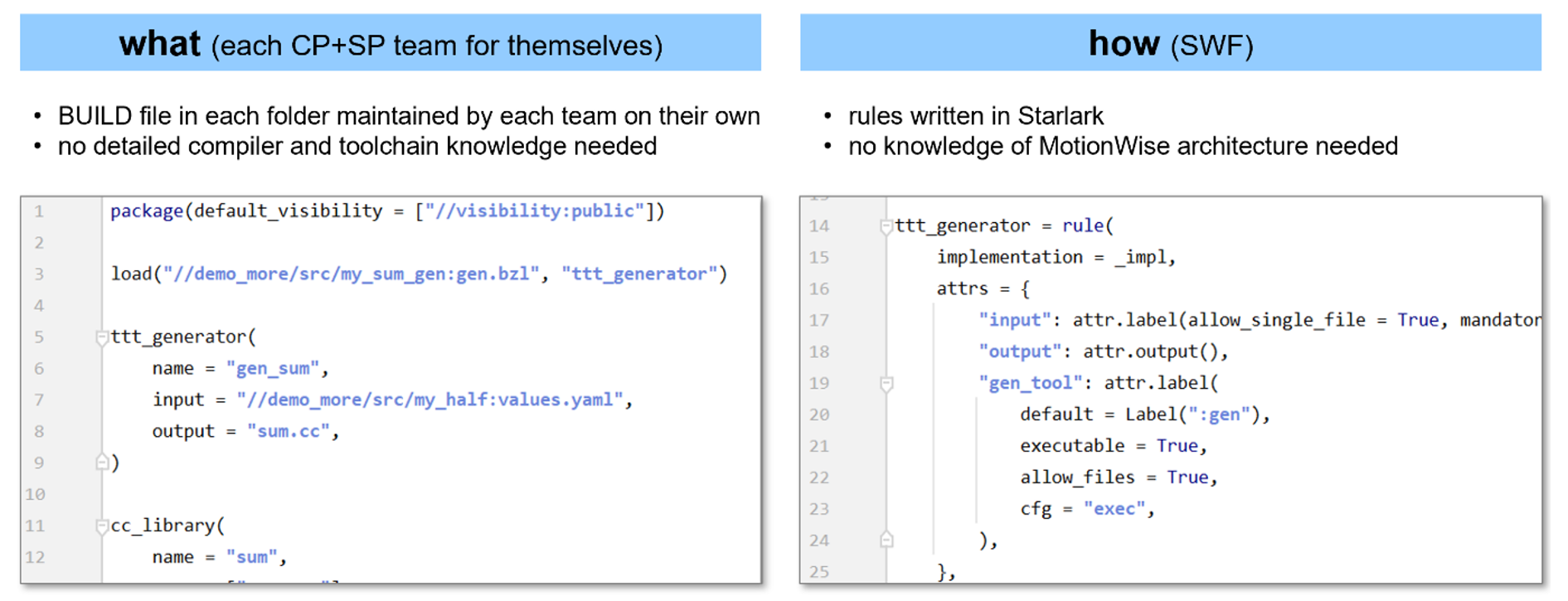
Firstly, developers can concentrate on writing code and only need to understand how to write rules.
Secondly, given only a limited set of things that can be done with these rules, the system can optimize the build because certain assumptions always hold true.
For example, if compiling and linking depends on its declared inputs, the system can find out which steps can be done in parallel and which need to be sequential.
todo: put in the rules we created for scons here.